
Let me take a wild guess…
You’ve been throwing spaghetti at the SEO wall for years, hoping something sticks. Maybe you even hired that “SEO expert” your cousin’s friend’s neighbor recommended. (How’s that working out for you?)
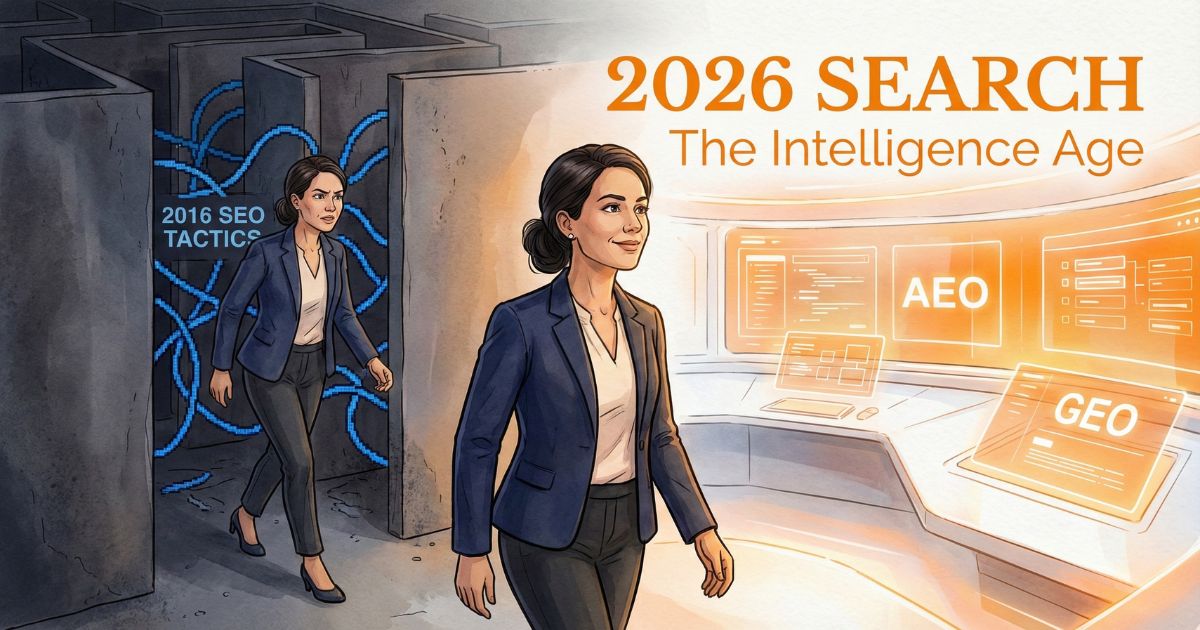
Or perhaps you’re still playing the 2016 game—tweaking keywords, chasing rankings, and praying the next Google update doesn’t body-slam your traffic into the basement.
I get it.
I’ve coached thousands of smart service business owners through that exact cycle: the panic when performance dips, the frustration when a competitor leapfrogs you, and the confusion when your “optimized” site still isn’t producing consistent leads. Most owners get trapped in tactical busywork—micro-optimizing for an algorithm they don’t control—while ignoring the bigger shift in how buyers actually search and decide in 2026.
But here’s the structural shift for 2026…
It’s not just SEO anymore. It’s Search.
Your prospects aren’t only Googling. They’re asking AI. They’re getting answers without clicking. And they’re making decisions faster than ever—based on what the machine can confidently summarize, quote, and validate. As outlined in Google’s guidance on AI features, AI-driven search experiences are fundamentally changing how websites are surfaced, summarized, and recommended. You don’t need 37 trends. You need the three that actually change decisions.
Table of Contents
- The 2026 Search Shift: The Trend Radar
- The Separation Point: Why 2016 SEO Tactics Are Killing Your Growth
- The Intelligence Stack: SEO vs. AEO vs. GEO
- The Three Pillars of Trust
- Trend #1: Information Gain (The Brain)
- Trend #2: AI-Readable Infrastructure (The Voice)
- Trend #3: Distributed Authority (The Jury)
- The Orchestrator Shift: Your 2026 Roadmap
- FAQ: Search in the Intelligence Age
Executive Summary (TL;DR)
In 2026, search has shifted from Information Retrieval to Intelligence Synthesis. To win, service businesses must focus on the Three Pillars of Trust: Information Gain (The Brain), AI Infrastructure (The Voice), and Distributed Authority (The Jury).
The 2026 Search Shift: The Trend Radar
Before we dive into the “how,” you need to understand the “what.” The table below summarizes the tectonic shift happening in the major Search Trends for 2026. If you aren’t aligning your budget to these three pillars, you’re essentially lighting money on fire.
| 2026 Search Shift | What’s Changing | Why It Matters | Who Wins |
|---|---|---|---|
| Trend #1: Information Gain | AI compresses “me-too” content; surfaces original clarity. | If you’re not quotable, you’re invisible. | Experts with frameworks + proof. |
| Trend #2: AI Infrastructure | Entities, structure, and schema shape machine interpretation. | Confusion kills visibility across AI search. | Businesses with clean hierarchy and clear data. |
| Trend #3: Distributed Authority | Trust signals live beyond your website (corroboration). | AI looks for third-party validation before recommending. | Brands with real-world mentions and demand. |
The Separation Point: Why 2016 SEO Tactics Are Killing Your Growth
If you’re still chasing blue links and stuffing keywords like it’s 2016, you’re not just behind. You’re training yourself to win a game buyers aren’t playing anymore.
Somewhere in the mid-2010s, search started shifting from “matching words” to “understanding intent.” That was the early warning sign. In 2026, that shift has exploded into full-blown answer engines—where the question isn’t “Can you rank?” It’s “Can you be trusted as the answer?”
Fast forward a decade to 2026 and that gap has become a canyon. We’re stepping out of what I call the Information Age—where the goal was to find information—and into the Intelligence Age—where the goal is to get a decision-ready answer. In the old model, search engines retrieved options and humans compared. In the new model, AI synthesizes options and humans simply validate the result.
The funnel didn’t disappear… it compressed.
And when the funnel compresses, clarity and credibility become more important than volume and keyword density. If your strategy is still built on “more content,” you’re producing noise while the market is searching for a clear signal—something specific, credible, and easy to trust. Otherwise, you’re creating content that doesn’t move the needle.
“The problem isn’t growth. It’s structure. In the Intelligence Age, if the machine can’t find you, quote you, and trust you—you don’t exist.”
The Intelligence Stack: SEO vs. AEO vs. GEO
Direct Answer: In 2026, “Search” is a stack: SEO (The Phonebook), AEO (The Direct Answer), and GEO (The AI Recommendation).
Most service business owners get paralyzed by the acronyms. Don’t be. You don’t need to be a technical guru; you just need to understand which layer supports which outcome. I explain this stack to coaching clients as a visibility ladder—moving from being “listed” to being “quoted” to being “recommended.” Understanding these Search Trends for 2026 is the key to building a business that is built to be understood.
SEO: The Digital Phonebook
SEO is the foundation. It helps you show up on the list when someone searches for a specific service in your area. In 2026, you still need it. But SEO alone won’t make you the obvious choice when AI is filtering options before the buyer even clicks. You need it to be found, but it won’t help you stand out in an environment where AI is doing the filtering for the buyer.
AEO: The Direct Answer
AEO is about being the answer. When a prospect asks a question and a tool returns a single “best response,” AEO influences what content gets summarized and cited. If you aren’t building content that can be extracted cleanly—definitions, frameworks, FAQs, and decision filters—you’re simply harder for the machines to quote.
GEO: The AI Recommendation
GEO is the recommendation layer. It’s how generative systems form a view of your brand’s credibility based on consistent signals, clarity of positioning, and corroboration across the web. This isn’t about stuffing keywords; it’s about being an established entity the machine can trust.
 The 3-layer stack for modern visibility: Building from the foundation of SEO into the AI-driven worlds of AEO and GEO.
The Three Pillars of Trust
To dominate search in 2026, you have to nail these three pillars. When you align them, you aren’t just “optimized.” You’re orchestrated.
- The Brain (Information Gain): Do you have a unique perspective, or are you repeating consensus content?
- The Voice (Infrastructure): Can machines understand you clearly, or are you buried in a messy site?
- The Jury (Distributed Authority): Does the internet corroborate your expertise?
Trend #1: Information Gain (The Brain)
Direct Answer: In 2026, AI compresses consensus content and elevates Information Gain—original insights and proprietary frameworks derived from real-world experience.
Most business blogs are the content version of a beige minivan: reliable, predictable, and completely forgettable. If your content sounds like everyone else’s, AI will turn your 2,000-word article into a two-sentence summary and give the credit to someone else. It has no reason to send a human to your site if it can produce the same generic advice without you. AI models reward original data and unique logic; they punish repetition.
Here’s the golden nugget: AI doesn’t reward effort. It rewards signal.
If you’re rehashing the same tips as your competitors, you’re not building authority—you’re feeding the model. To win, you have to systematize your genius. Stop explaining the basics. Start publishing named frameworks and decision filters that only you can credibly teach. You need to provide the “Aha!” moment that forces the machine to cite you as the source of a specific, non-generic idea.
The Move: Take one core process you use to get results and turn it into a named framework or checklist. If AI can’t pull a clean, quotable block from your page, it won’t.
Key Takeaway: If you aren’t quotable, you’re invisible.
 AI is the world’s greatest librarian, but human expertise is the author. “Information Gain” is the unique new value you create that the AI doesn’t already have.
Trend #2: AI-Readable Infrastructure (The Voice)
Direct Answer: Machine-readability is the 2026 standard. Your site must use clean structure, consistent entity signals, and schema that removes ambiguity so AI can confidently classify who you are and what you solve.
Humans feel clarity. Machines infer it. If you want the deeper play-by-play on how to tighten this up, start with AI Search Optimization—because in 2026, the machine has to understand you before it can recommend you.
If your website reads like a vague brochure with generic promises, AI won’t “guess” that you’re the best fit. It will recommend the competitor whose structure is cleaner and whose positioning is easier to classify. It prioritizes the business it can “understand” with the least amount of computational effort, leaving “clever” marketers in the dust. In 2026, “technical SEO” isn’t mainly about meta tags. It’s about entity clarity.
Clarity trumps clever… every time.
If you want a quick, practical checklist to sanity-check the basics, review our website best practices before you start chasing shiny AI tactics.
If your site is built like a maze, don’t be surprised when the AI refuses to enter. You have to serve both audiences simultaneously. Humans need to see your results; machines need to parse your data without having to guess your intent.
The Move: Audit your money pages. Make sure you have one clear H1, strong H2s that match real buyer questions, and schema markup that reduces ambiguity.
Key Takeaway: Confusion is the ultimate visibility killer in the Intelligence Age.
 In the Intelligence Age, if the machine can’t read it, the customer won’t see it. Clean infrastructure is the ‘voice’ that speaks to AI.
Trend #3: Distributed Authority (The Jury)
Direct Answer: Authority in 2026 is a distributed signal. AI validates claims by looking for corroboration—reviews, mentions, and brand demand—across the digital ecosystem.
Even with a well-optimized site, you can still lose. Because in 2026, your website is no longer the sole source of truth. AI systems are designed to be skeptical; they look for proof that the rest of the internet agrees with you. If you are the only one calling yourself an expert, the machine won’t trust you enough to recommend you, and it certainly won’t grant you the “expert” badge that triggers a generative recommendation.
If you have a beautiful site but no branded search demand—people searching for you by name—you’re easy to ignore. In 2026, authority isn’t self-declared… It’s corroborated. That means you need proof outside your website: reviews, associations, interviews, partnerships, and mentions in places your audience already trusts. And yes—this is also where a smart link-building strategy stops being “SEO busywork” and starts becoming proof.
The Move: Pick one external channel and build depth for 30 days. Force the AI to see corroborating signals that validate your expertise.
Key Takeaway: Brand is visibility, but Authority is influence.
 In 2026, authority isn’t self-declared—it’s corroborated by the rest of the web. The ‘Jury’ must agree that you are the expert.
The Orchestrator Shift: Your 2026 Roadmap
Business is simple, but it’s not easy.
The shift from 2025 to 2026 is a shift from operator thinking (ranking for keywords) to orchestrator thinking (becoming the trusted answer). If you’re hitting a flat spot in your growth, it’s rarely because you aren’t working hard enough. It’s because your strategy is structured for an older era. You are trying to brute-force your way onto Page 1 instead of building an authoritative engine that the Intelligence Age rewards.
Growth doesn’t fix structure. Structure enables growth.
Your Next 5 Moves:
- Tighten one money page: Make it answer-ready in the first 10 seconds.
- Publish one information-gain asset: Turn a core process into a named framework.
- Audit your entities: Ensure the business name, service, and location signals are consistent across all pages.
- Claim one external channel: Spend 30 days stacking proof beyond your own domain.
- Track what matters: Leads and branded search—not just rankings. If you need a baseline dashboard, start with these website metrics that matter and stop obsessing over vanity numbers.
FAQ: Search in the Intelligence Age
Can AI recommend local service providers?
Yes. In 2026, AI search engines (GEO) prioritize service providers that have clear “entity signals” and strong third-party corroboration. If your local business is cited frequently by industry sources and local news, you are far more likely to be the recommended choice.
What is the difference between SEO and AEO?
SEO helps you show up in a list of results. AEO (Answer Engine Optimization) is about ensuring your content is structured so that AI can “read it back” as a direct answer to a user’s question.
Does “Information Gain” mean you have to write more content?
Nope. It means you have to write better content—content that adds something new to the conversation. Instead of rehashing the same tips as everyone else, publish original data, proprietary frameworks, and unique insights your market can’t get from generic, recycled content.
So Let’s Wrap This Up…
The Information Age was about being found. The Intelligence Age is about being trusted. If you build information gain, machine-readable clarity, and authority that lives beyond your website, you don’t have to chase every trend. You become the signal. Those who fail to evolve will be summarized into oblivion, while those who embrace the orchestrator mindset will dominate their categories.
The choice is yours.
You can keep grinding in the Owner’s Prison, hoping the next algorithm update doesn’t body-slam your traffic. Or you can evolve—build a search strategy that is structured for the Intelligence Age. Implementing these shifts isn’t a weekend project; it’s an architectural overhaul.
If you’ve never done a real website audit, you’re basically making “optimization decisions” with a blindfold on.
Ready to Stop Tweaking and Start Building?
In 2026, the biggest mistake service businesses make is trying to retrofit modern search into an outdated website foundation.
If you want help doing this the right way, book a Website Systems Discovery Session. We’ll quickly determine whether your site is:
- structurally sound (and just needs targeted upgrades), or
- fundamentally outdated (and needs a rebuild designed for modern search behavior)
No fluff. No generic advice. Just a clear direction.

